SWLAW Blog
March 28, 2026
Southwestern Law School Mourns Professor Isabelle R. Gunning, Civil Rights Leader, Legal Scholar, and Teacher
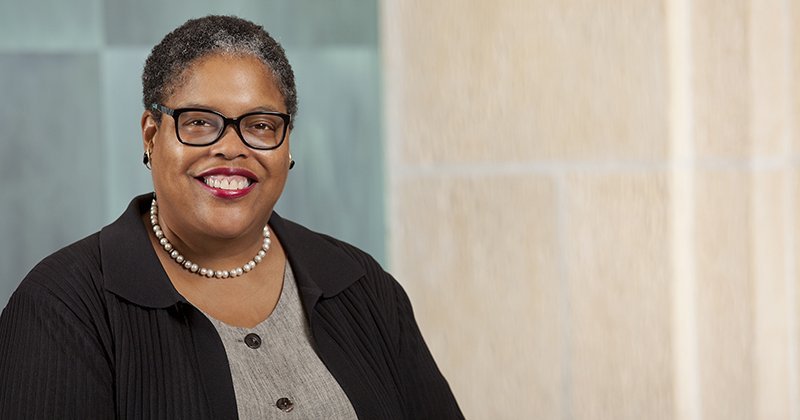
With profound sadness, we share that Professor Isabelle R. Gunning passed away in the early hours of March 28, 2026, in Los Angeles.
Professor Gunning was a beloved member of the Southwestern Law School community for more than three decades. She joined the faculty in 1992 and served with distinction as the inaugural Mayor Tom Bradley Professor of Law and the inaugural Director of the Critical Race, Gender, and Sexuality Studies Concentration. Across generations of students, she was admired for the seriousness of her intellect, the moral clarity she brought to difficult questions, and the depth of care with which she taught, mentored, and challenged those around her.
Her life in the law was shaped early by the civil rights struggles of the 1970s and by a belief she carried throughout her career: that the law, even in a society marked by profound inequality, could still be made to serve justice. After earning her B.A. in economics and her J.D. from Yale University, she clerked for Chief Judge William Bryant of the United States District Court for the District of Columbia, served as a staff attorney with the Public Defender Service in Washington, D.C., and worked with the Southern Africa Project of the Lawyers’ Committee for Civil Rights Under Law. In that role, and later as a delegate to the United Nations Council on Namibia Seminar, she helped connect the struggle for civil rights in the United States to the larger global fight against apartheid and colonial domination. Before joining Southwestern, she taught for six years at UCLA School of Law.
At Southwestern, she regularly taught Evidence, often in the SCALE program, where she pioneered “Evidence Labs” that allowed students to practice using evidence rules in a realistic courtroom setting. She also taught Alternative Dispute Resolution and Interviewing, Counseling & Negotiation. She had high expectations of her students, understanding the important roles they would play as future attorneys, yet was always encouraging and supportive. Beyond the classroom, students sought her out for guidance about life, law school, and the legal profession.
Professor Gunning built a body of scholarship that shaped conversations about race, gender, sexuality, human rights, and dispute resolution. She was a foundational voice in critical race feminism and multicultural legal theory. Her work challenged legal scholars, lawyers, and mediators to see more clearly the hidden structures of power that conventional language about neutrality or fairness often conceals. In writings such as Arrogant Perception, World-Traveling, and Multicultural Feminism and Stories from Home, she insisted that law could not be honestly understood apart from lived experience, identity, history, and the unequal conditions under which people meet the law. She brought that same seriousness to legal pedagogy, elevating clinical legal education as a rigorous field of scholarship and serving as a founding co-editor-in-chief of the Clinical Law Review.
Professor Gunning was one of those rare people for whom intellectual life and public life belonged to the same moral project. She served as president of the ACLU of Southern California from 2005 to 2009, becoming the first African-American woman to hold that office. She later represented the affiliate on the National ACLU Board. Under her stewardship, the organization fought expanded federal surveillance, defended reproductive freedom, challenged deportation abuses, and resisted punitive policies that fell with particular force on vulnerable communities.
Her civic leadership in Los Angeles was equally consequential. She was appointed to the Los Angeles County Commission on Human Relations. Elected by her peers to serve as its president, Professor Gunning brought extraordinary discipline and courage to some of the region’s most difficult public questions. She presided over extensive public hearings on policing and community trust in marginalized communities, work that culminated in the Commission’s 2020 report and educational video Redefining Policing with our Community. Under her leadership, the Commission also helped advance efforts to embed anti-bias education more deeply in county governance, public services, and law enforcement. She understood that the work of justice required not only critique, but institutional change.
That same conviction animated the quieter, less visible labor to which she gave so much of her life. Professor Gunning served for years as a mediator, labor arbitrator, civil service hearing examiner, and community facilitator. She devoted thousands of hours to pro bono mediation, worked with the Martin Luther King Jr. Dispute Resolution Center and the Asian Pacific American Dispute Resolution Center, trained others in arbitration and mediation across religious and cultural differences, and continued late into her career to deepen her practice of restorative and healing work. Initiatives such as Days of Dialogue and Trust Talks reflected something essential about her: she was willing to go where conflict was hardest, not because she imagined resolution would be easy, but because she believed people owed one another the discipline of honest encounter.
Her work was recognized across the legal and civic worlds, including with the Beacon of Justice Award from the Friends of the Los Angeles County Law Library in 2023. Yet those honors, while fitting, tell only part of the story. Her truest legacy lives on in the students she shaped, the colleagues she strengthened, the communities she served, and the intellectual and moral demands she refused to let others evade.
For Southwestern, her death is a profound loss. We mourn a distinguished scholar, an exacting and generous teacher, a powerful civic leader, and a person of uncommon integrity whose life enlarged the meaning of justice in Los Angeles and far beyond it. Dean Darby Dickerson shared that, “Isabelle’s passing is a profound loss for Southwestern and for Los Angeles. She was a source of constant strength and wisdom that we will sorely miss. But influence endures in her students, her faculty colleagues, the Southwestern staff, and everyone whose life she made better.”
We extend our deepest condolences to Professor Gunning’s family, loved ones, friends, colleagues, former students, and to all those whose lives were changed by her wisdom, courage, and example.
A memorial honoring Professor Isabelle R. Gunning will be held at Southwestern Law School on Monday, April 20, 2026, at 6:00 p.m. Family, friends, colleagues, and members of the Southwestern community are invited to gather in celebration of her extraordinary life and enduring legacy. Register Here.
In lieu of flowers, donations will be graciously accepted in her memory to support the Public Interest Law Committee. Professor Gunning was passionate about the work of this Southwestern organization and the outstanding community of students and alumni. Click here to make a donation.
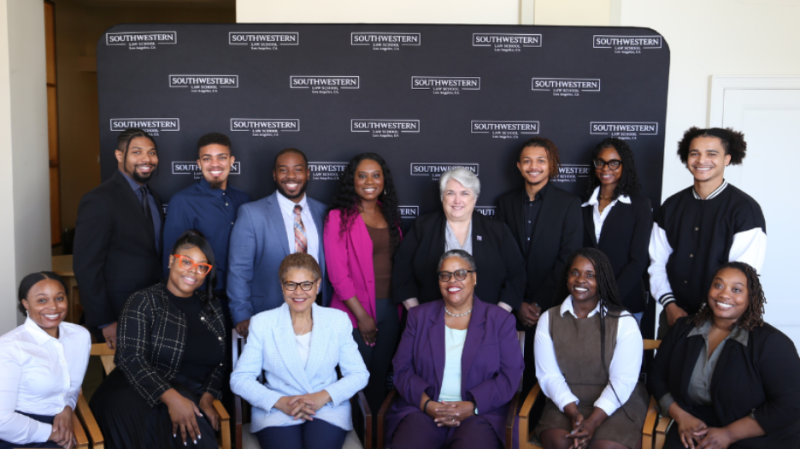
With Los Angeles Mayor Karen Bass, Dean Darby Dickerson, and members of Southwestern’s Black Law Students Association (BLSA) chapter, February 2024.