SWLAW Blog | Faculty Scholarship Spotlight
January 26, 2026
Faculty Appearances: December Highlights
Our December faculty digest highlights Southwestern scholars whose work is shaping courts, campuses, national media, and beyond.
Luke Boso
- In December, Luke’s most recent Article, Exclusionary Expressive Conduct, was reprinted in the annual anthology: First Amendment Law Handbook (Thomas Reuters, 2025-26 ed.). Luke’s Article is one of fourteen selected for this year’s anthology, alongside pieces from First Amendment experts like Cass Sunstein, Jack Balkin, Evelyn Douek, and Genevieve Lakier.
Meera Deo
- In November, Meera was quoted in a number of news outlets—including Reuters, ABA Journal, National Jurist, Law360, and Above the Law (as the “Quote of the Day”)—discussing the 2025 LSSSE Annual Report, Disability in Law School. The report reveals that 20% of law students nationwide have a disability, and most disabilities are invisible—such as anxiety, depression, and ADD/ADHD. Meera’s quotes stress the need for greater institutional support for law students with disabilities.
Andrea Freeman
- On December 18, Andrea was the featured guest on the Plantstrong Podcast in an episode entitled: Here’s the Real Story Behind What’s On Your Plate (available to watch here).
- On December 12, Professor I. India Thusi (Indiana University Maurer School of Law) published a review of Andrea’s most recent book on The Journal of Things We Like (Lots) (“JOTWELL”): Ruination As Policy: The Legal Architecture of Food Waste. Professor Thusi's concluding impression: “This book reminds us that the law is not neutral in its silences and omissions--especially when it comes to who gets to eat, what they must eat, and who must go hungry. In a legal landscape still too quick to dismiss socioeconomic rights as politics rather than justice, Freeman gives us the tools to argue otherwise. Food is not merely nutrition. It is memory, dignity, identity--and access to it is structured by the state.”
Faisal Kutty
- On December 9, Faisal published an Op-Ed in the Toronto Star: New Federal Laws Risk Criminalizing Dissent While Expanding State Power. Analyzing a series of proposed federal bills in Canada, Faisal argues that the expansion of surveillance, policing discretion, and speech-related criminalization undermines democratic accountability, free expression, and protest rights under the guise of public safety.
- On December 3, Faisal participated in a Newsweek contributors’ debate alongside Paul du Quenoy (President of the Palm Beach Freedom Institute): Has President Trump Ushered in an Era of Peace in the Middle East? Faisal argues that claims of peace mask ongoing violence, thwart aid, and facilitate the denial of Palestinian self-determination, and he asserts that “peace” built on coercion and impunity cannot endure.
- On November 24, Faisal published an Op-Ed in Al Jazeera: What Is Really Behind Greg Abbott’s ‘War on Sharia.’ In this piece, Faisal examines the political use of anti-Sharia rhetoric to stoke fear and marginalize Muslim communities in the United States, and he argues that such campaigns are less about law or security and more about weaponizing Islamophobia to undermine religious freedom, civic participation, and pluralistic democracy.
- On November 18, Faisal published an Op-Ed in Newsweek: Sudan’s Genocide Is Happening in Plain Sight—and the West Is Enabling It. Drawing from international law, human rights reporting, and geopolitical analysis, Faisal argues that Western governments’ selective moral outrage and continued arms transfers have contributed to impunity and prolonged civilian suffering.
- On October 29, Faisal published an Op-Ed in Newsweek: Mamdani’s Rise Represents a Rejection of Fear. In this piece, Faisal examines political attacks against New York mayoral candidate Zohran Mamdani, and he discusses their broader implications for religious freedom, democratic participation, and equal citizenship. Invoking constitutional principles and civil rights history, Faisal argues that fear-based attacks of Muslim candidates undermine democratic values and reflect a broader pattern of political Islamophobia.
Orly Ravid
- On December 8, Orly was quoted in a piece published in the LA Daily Journal: Netflix-Warner merger sparks concern over consolidation, shrinking opportunities. Orly explained that the proposed merger will fuel rising anxiety in the film industry, and specifically for independent filmmakers who already face diminishing opportunities for project financing or distribution.
John Tehranian
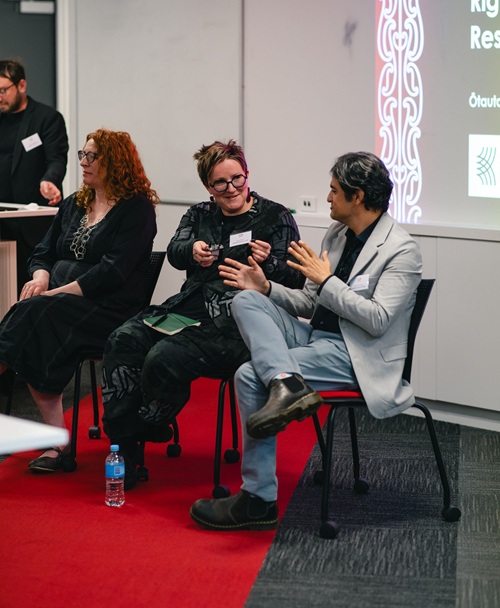
- On December 3-5, John attended the 2025 Conference of the Law and Society Association of Australia and New Zealand at the University of Canterbury in Christchurch, New Zealand. This year’s Conference theme was Rights,Relationality, Resilience, Reciprocity, and John gave a talk on his recently published book: The Secret Life of Copyright: Intellectual Property & Inequality in the Age of AI.
Rachel VanLandingham
- In December, Rachel was a regular and reliable media expert on issues of national security and military actions, appearing on a mainstream news program approximately fifteen times. The following is a representative sample:
- On CBS News, Rachel assessed the legality of the U.S. seizure of an oil tanker in international waters.
- On ABC News, MS Now, and CNN, Rachel discussed the illegality of U.S. boat strikes in the Caribbean.
- On NPR, Rachel explained why the U.S. military likely committed murder by killing shipwrecked, defenseless men floating adrift in the Caribbean. This action could constitute a war crime under normal circumstances, she explained, but there is no ongoing war to render the law of war applicable.
- In December, Rachel also appeared in numerous news articles explaining military law, the law of war, and international law. Rachel's contributions to a piece published in Business Insider are particularly notable given how her conversations with journalists ultimately shaped the piece: Troops worry any speech with a political undertone could cost them their careers.
- In November and December, Rachel published two MS Now Op-Eds examining a video produced by elected officials urging U.S. service members to disobey illegal orders and the Trump Administration’s subsequent abuses of law and retribution campaign against those officials.
- November 26: Congress shouldn’t tolerate Pete Hegseth’s attack on Sen. Mark Kelly. In this piece, Rachel acknowledges that the lawmakers’ video “could have been more nuanced,” but she explains that the message “certainly wasn’t criminal—not by any stretch of the imagination.” Of the Administration’s subsequent acts of retribution against Senator Kelly, Rachel argues: “Because he’s trying to punish a lawmaker, Hegseth’s response is also a threat to the separation of powers and represents a gross dereliction of the secretary’s duties running the Pentagon.”
- November 21: Guidance from Democrats to disobey illegal orders is of no use to our service members. In this piece, Rachel explains that the “lawmakers’ video is dangerously vague and dangerously wrong on the law, putting our service members in even more of a moral quandary than they already face. We don’t know what military orders the lawmakers are referring to—since they glaringly fail to be specific—but it’s likely that such orders aren’t so patently unlawful that they carry a legal duty to disobey. That means such orders carry a presumption of legality and disobeying them would come at a great risk to a service member’s career and liberty.”