London Summer Program

Apply to the London Summer Abroad Program
Welcome to the 22nd Annual Summer Law program in London, England, hosted and presented by Southwestern Law School. Studying law in London is an experience of a lifetime. At Southwestern, we are thrilled to present two distinctive tracks of study: the Entertainment Law Track and the Public Interest Track. This five-week program provides an exceptionally unique and inspiring educational and international networking experience. No matter where you study law, we encourage you to take advantage of this career-enhancing opportunity.
For law students looking for a deeper global perspective, Southwestern offers a study abroad program in London.
- 2026 Application (PDF)
- 2026 Consortium Agreement (PDF) (For Visiting Students Only)
- Online Application and Seat Deposit Payment Form
Southwestern Law School, under the auspices of the Biederman Entertainment, Media, and Sports Law Institute, will host a five-week Summer Program in International Entertainment and Media Law and Public Interest Law at The University of London SOAS, Brunei Gallery from June 21 to July 24, 2026.
This unique and exciting program offers a variety of academic, cultural, and social experiences through:
- Courses on international entertainment, art, music, AI in the entertainment industry, and public interest law
- Instruction provided by U.S. and British faculty with extensive international experience
- Guest lecturers on course-related topics
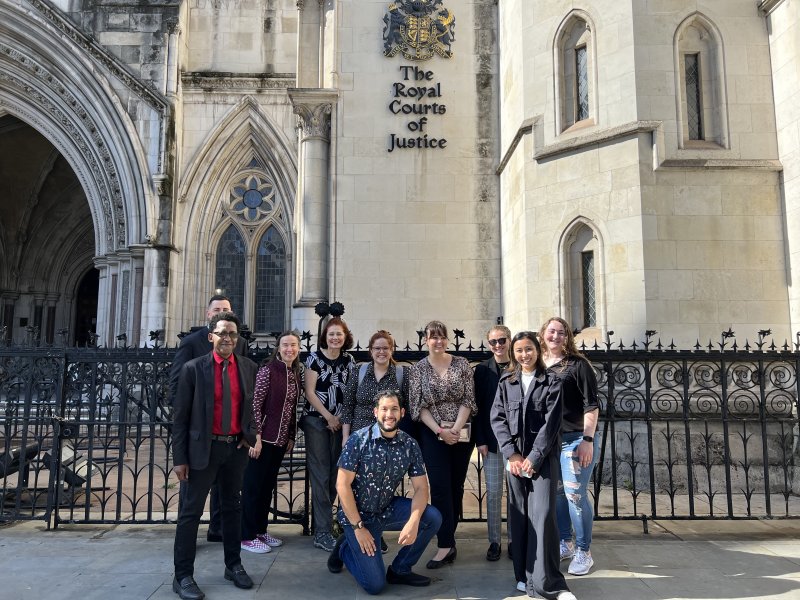
- Field excursions to the Royal Courts of Justice and other legal, entertainment, media, and cultural institutions in London
Program Details:
Dates: June 21 – July 24, 2026 | Brunei Gallery
Calendar
Saturday, June 20 — Students check into dorm rooms at College Hall
Sunday, June 21 — Mandatory Orientation followed by Thames Sightseeing River Cruise
Monday, June 22 — Classes Begin
Wednesday, July 22— Last Day of Classes
Thursday, July 23 — Final Exams for Int’l Entertainment Law, Int’l Live Theatre, and Children and Migration: Treatment of Migrant Children Under International and U.S. Law
Friday, July 24 —Final Exams for Int’l Art Law, AI and the Entertainment Industry, and Food Justice ︱Farewell Dinner Party
Sunday, July 26 — Last day to vacate College Hall
Course Schedule
Track 1: International Entertainment Law
Monday –Thursday 9:00 a.m. – 11:00 a.m. | International Entertainment Law (3 units) OR International Music Law (1 unit)/Int’l Live Theatre (2 units)* |
Monday –Thursday 11:10 a.m. – 1:10 p.m. | AI and the Entertainment Industry (3 units) OR International Art Law (3 units) |
Track 2: Public Interest Law
Monday –Thursday 9:00 a.m. – 11:00 a.m. | Children and Migration: Treatment of Migrant Children Under International and U.S. Law (3 units) |
Monday –Thursday 11:10 a.m. – 1:10 p.m. |
Food Justice (3 units) |
*Students taking Int’l Music Law must take Int’l Live Theatre Business & Legal Affairs.
All students must take at least three units and may take six units. Courses with an enrollment of less than seven students will be canceled.
- Course Descriptions
AI and the Entertainment Industry (3 units)
This course examines the legal and ethical issues arising from the development and use of artificial intelligence-based tools in the context of the entertainment and media industries. The course will provide a basic introduction to the underlying technology and its development and use in the entertainment industry before delving into the legal issues. Students will be introduced to relevant legal principles as they relate to the topic (such as intellectual property, labor, privacy, and contract law). The course will also look at the legal and regulatory environment, with an international perspective, and the actions taken by the entertainment unions in connection with AI's impact on their members. As this is an evolving area, the course will evolve in terms of topic coverage.
International Art Law (3 units)
Artworks reflect the cultures of their creators, but artworks themselves know no boundaries. Perhaps for this reason, the most interesting and newsworthy issues in art law today are international law issues. This course will address international legal issues related to art as a creative endeavor, art as an article of commerce, and art as a significant cultural artifact. Issues to be examined include international jurisdictions and choice of law conflicts; legal aspects of international sales and resales; legal duties of international dealers and auctioneers; international sales and import taxes required on cross-border shipment of artworks; international recovery of artworks plundered during wartime; and international copyright (and other) protections for artists and their work.
International Entertainment Law (3 units)
International Entertainment Law is a course that explores the intersection of copyright, trademark, moral rights of personality, and contract transactions and disputes in the global entertainment industry. This course provides a comparative law look at the interplay of international copyright treaties through the lens of U.S. and foreign nations, and how international norms impact contract-making and breaking between U.S. and foreign entities. Among the fascinating topics are the treatment of indigenous peoples and their creative works in the law. International Entertainment Law is a class about movies, television, music, and video game transactions and the impact of new technologies, such as AI, on global entertainment projects. From Michael Jackson's copyright infringement lawsuit arising from "Wanna Be Starting Something" to distribution rights for the Beatles’ "Yellow Submarine", International Entertainment Law provides an exciting look at the entertainment industry on the global stage.
International Music Law (1 unit)
This course provides an overview of the differences in law and practice between the United States and other leading music markets around the world. Key copyright and related legal concepts will be examined in terms of their impact on artists, songwriters, producers, and the attorneys who represent them.
Emphasis will be placed on real-world issues that arise in cross-border transactions, such as catalog sales, publishing splits, territorial licensing, and monetization challenges in emerging markets. Students will also gain exposure to the impact of local customs and business practices on dealmaking. The course includes a practical drafting component where students will engage with sample clauses and short exercises, preparing them to address the complexities of global music contracts in practice.International Live Theater Law (2 units)
Bringing a live stage production to Broadway, the West End, a regional theater, or on the road is no easy feat. Developing the environment and atmosphere for audiences to immerse themselves in the story presented takes a great deal of creativity, artistry, patience, and money! Ultimately, though, a live stage performance comes together because of the collaboration of many people, and it is these relationships we explore in International Live Theater Law.
The course moves from an overview of copyright matters and financing commercial theater to a deep dive into the people who make theater happen - producers, playwrights, directors, performers, designers, stage crew, box office managers, and marketing teams. For each of these groups of people, the course will review (a) any trade unions or associations that are involved in the fair labour negotiations and deals that are made through collective bargaining agreements and (b) other typical deal terms and agreements governing talent contracts. We'll even explore ethical marketing practices that derive from potential legal implications.
After reviewing [International Theater Law] under the Broadway/West End spotlight, we'll turn our study to other forms of theater that producers must utilize or plan for, including pre-Broadway/West End tryouts, Off-Broadway/West End runs, touring companies, regional & local productions, and replica vs. non-replica productions.
Finally, we'll tie it all together to understand how the whole live theater ecosystem functions (and how the ecosystem relates to other entertainment mediums) and apply what we've learned to develop a checklist of business and legal considerations for live theatrical productions. Course materials will include case law readings, case studies of productions (through readings and documentary media), and research materials found through legal research systems. Additionally, students will be introduced to expert practitioners in London as guest speakers and watch recommended shows while in London to expose themselves to the art form.
Food Justice (3 units)
This course introduces students to essential topics in food justice that cover all aspects of the food chain, from production to consumption. It explores the historical origins of food inequality and how critical perspectives can inform modern food law and policy. The class will include guest lecturers and field trips, giving students the opportunity to experience and engage in the London food scene and food activism, including participating in London Climate Action Week. Students will engage in class debates on cutting-edge food justice issues and write and workshop final papers.
Children and Migration: Treatment of Migrant Children Under International and U.S. Law (3 units)
The course will explore the Convention of the Rights of the Child (CRC) as the centerpiece of legal protections for children under human rights law. Students will review and consider the United Nations Committee on the Rights of the Child and the Declaration of the Rights of the Child, and the effectiveness of the United Nations oversight committee.
This course will introduce students to U.S. immigration law and the protections for children in the custody of the Office of Refugee Resettlement (ORR) under the Department of Health and Human Services (HHS). The course will review forms of immigration relief for unaccompanied children and how claims are processed in the United States. The course will introduce asylum, Special Immigrant Juvenile Status, U nonimmigrant status, human trafficking and T visas, and the Violence Against Women Act. It will include a discussion of the Trump Administration’s Family Separation Policy and family detention, and the litigation efforts that led to the social outcry against the policies. It will also review the protections of migrant children in immigration detention established under a nationwide settlement.
Faculty
- Camille Anidi
Professor Camille Anidi will teach the International Music Law course.
Camille Anidi is a Billboard-recognized music lawyer with more than six years of experience at the intersection of entertainment, intellectual property, and global deal-making. Licensed in New York and trained in London, she translates real-world music industry knowledge into transformative legal education. She has a strong record of mentoring aspiring lawyers, breaking down complex IP concepts, and sparking classroom engagement with practical insight and cultural fluency.
- Andrea Freeman
Professor Andrea Freeman will teach the Food Justice course.
Andrea Freeman is a national and international expert on the intersections between critical race theory and food policy, health, and consumer credit. She is a Fulbright scholar and the author of Ruin Their Crops on the Ground: The Politics of Food in the United States, from the Trail of Tears to School Lunch (Metropolitan 2024), winner of the L.A. Times Book Prize in History and James Beard Award for Food Issues and Advocacy, and Skimmed: Breastfeeding, Race, and Injustice (Stanford University Press 2019), law review articles, book chapters and reviews, and op-eds. Skimmed is currently in development for a documentary with Topic Pictures.
Her work has been featured in the Washington Post, New Yorker, Los Angeles Times, The Guardian, Salon, Huffington Post, USA Today, Strict Scrutiny, The Root, Lit Hub, Yahoo! News, The Atlantic, NPR Shots Blog, Pacific Standard, The Conversation, Medium, Atlanta Journal-Constitution, and National Library of Medicine, and she has appeared on ABC News, CBS News, PBS News Hour, The Takeaway, Here & Now, Food with Mark Bittman, Point of Origin, Newstalk Irish National Radio, Heritage Radio Network, The Electorette, Hawaii Public Radio.
- Kevin Greene
Professor Kevin Greene will teach the International Entertainment Law course.
Kevin J. Greene joined Southwestern’s faculty in 2020. Professor Greene is a nationally recognized entertainment and intellectual property law scholar and an expert witness consultant for copyright, trademark, publicity rights, and entertainment contract disputes. He is a highly committed, outstanding teacher as well as a passionate leader and an IP law influencer. He teaches Contracts and Copyright Law.
Professor Greene was most recently a tenured Professor of Law at Thomas Jefferson School of Law in San Diego. He has also been a visiting professor at the University of San Diego School of Law. In addition to Contracts and Copyright, he has also taught IP, Entertainment Law, Music Law, Publicity Rights, International Entertainment Law, and IP in the Cannabis Industry.
Before becoming a law professor, Professor Greene practiced law in New York at the premier law firm of Cravath, Swaine & Moore, where he represented high profile companies such as Time Warner and HBO in litigation matters. He later joined New York’s top entertainment law boutique firm, where he represented clients such as film production companies, including Director Spike Lee’s 40 Acres and a Mule film company, iconic music artists including Harry Connick, Jr., Bobby Brown, and the seminal rap group Public Enemy. Professor Greene was the first law professor voted a Top Ten attorney by the San Diego Bar in the field of IP in 2005.
Professor Greene's scholarship has garnered national and international recognition in the area of intellectual property (“IP”) law, particularly his pioneering work on African-American music and inequality in copyright law. His article on abusive trademark litigation, published in the Harvard Journal of Law and Public Policy has been the centerpiece of law conferences at Syracuse Law School and NYU. Greene's copyright scholarship is cited in numerous legal publications and has been cited in Congressional hearings. His current project explores intellectual property in the context of hip-hop music.
- Henry Lydiate
Professor Henry Lydiate will teach the International Art Law course.
Professor Lydiate is an international art lawyer who has specialized in the law relating to visual art and design for over 35 years. A scholar-practitioner who has been a visiting tutor at leading UK art schools and colleges; former Visiting Professor in Art Law at the University of the Arts London; current educational portfolio includes designing and delivering international legal and art business modules for Sotheby’s Institute of Art and Southwestern Law School.
Commissioned in 1976 by the Arts Council of Great Britain and The Calouste Gulbenkian Foundation to conduct research into the legal needs of visual artists in the UK, which led to his establishing Artlaw Services, a non-profit national legal advice, and professional practice training service: Chairman and pro bono legal adviser and trainer until 1984. Founding partner of The Henry Lydiate Partnership LLP, the international art business consultancy whose current clients include artists, artists’ estates, collectors, agents & dealers, art fairs, auction houses, foundations, and public-facing art institutions. Henry has published numerous articles and publications and currently writes a regular Artlaw column published by Art Monthly since its first issue in 1976.
Henry received a Bachelor of Laws, LLB, from the University of Newcastle Upon Tyne, U.K. Former practicing Barrister and Pupil-master, Inns of Court, U.K.
- Stephen Pidcock
Professor Stephen Pidcock will teach the International Live Theatre Business & Legal Affairs course.
Stephen advises clients from the subsidised and commercial sectors on all areas of theatre and live performance, including commercial, licensing, intellectual property, and rights issues.
He also advises on areas of law, including charity, entertainment, marketing, publishing, fashion, leisure, and retail. Before qualifying as a solicitor, Stephen was a theatre publicist working in-house at the Royal Court Theatre and then for The Corner Shop PR in the West End and across the UK.
As a publicist, his clients included many of the leading West End theatre production companies. He is also an award-winning translator of new Italian plays, a member of SOLT / UK Theatre and the Charity Law Association, and a trustee of the Bush Theatre and of Mercury Musical Developments. - Andrea Ramos
Professor Andrea Ramos will teach the Children and Migration: Treatment of Migrant Children Under International and U.S. Law course.
Andrea Ramos brings many years of experience as a public interest attorney and law professor to Southwestern, where she established and directs the Immigration Law Clinic. In the clinic, Professor Ramos teaches, supervises and trains law students on Special Immigrant Juvenile Status, U Nonimmigrant Visas (U Visa) and U-Adjustment of Status cases. Under her supervision, students represent children and adult survivors of domestic violence, sexual assault and other violent crimes in their immigration cases. Students work with clients who would otherwise be unable to access legal services.
Professor Ramos served as co-counsel in a class action lawsuit that successfully challenged an unlawful government policy denying Special Immigrant Juvenile Status (SIJS) to foster children, including obtaining a preliminary injunction enjoining the government from denying SIJS cases and from initiating removal against SIJS petitioners based on the policy.
Professor Ramos provides technical assistance on SIJS and U Visa cases. She has engaged in local and statewide advocacy regarding immigration options for survivors of crime. She also coordinates advocacy efforts with law enforcement agencies on U Visa certification policies and procedures.
- Danielle Van Lier
Professor Danielle Van Lier will teach the AI and the Entertainment Industry course.
Professor Van Lier is assistant general counsel, intellectual property and contracts at SAG-AFTRA. She began her position at the former Screen Actors Guild in 2000. She is responsible for managing SAG-AFTRA's third-party contracts and intellectual property, as well as other efforts aimed at protecting the rights of SAG-AFTRA and its members. Professor Van Lier has written several amicus curiae briefs on behalf of SAG-AFTRA and other parties in cases before the U.S. Supreme Court, the Ninth Circuit Court of Appeals and the California Supreme Court on issues such as rights of publicity, copyright, and the California Talent Agencies Act.
Before joining Screen Actors Guild, Professor Van Lier practiced law in Los Angeles. Prior to entering practice, she served as a legislative fellow in the U.S. House of Representatives.
Additional Details
- Frequently Asked Questions
Q. What is good standing for studying abroad?
A. To participate in study abroad programs, law students must have completed two semesters of full- or part-time study and be in good academic standing as determined by their home institution. If the student is not in good academic standing once grades are posted, the school in which the student is enrolled has the right to require the student to withdraw and return to the United States. In this case, the student may be refunded tuition, but associated costs, such as living expenses, housing, books, travel expenses, etc., will not be refunded. Students in their first year of school should consider their performance in the fall semester before applying.
Q. Will I need a passport or visa?
A. You will need a current, valid passport to travel abroad for the Entertainment and Humanitarian London Summer Program. You will not need a visa. That’s because you won’t be enrolled in a foreign study program; you’ll be enrolled in a US study program that happens to be taking advantage of UK facilities. Your passport must remain valid throughout your planned stay.
Q. Is there any other travel requirement to go to London?
A. You must apply to visit the U.K. by completing the new United Kingdom’s Electronic Travel Authorization (ETA) form and paying the required fee. For more information, check the Gov.UK website here: https://www.gov.uk/guidance/electronic-travel-authorisation-eta.
Q. How do I obtain a passport?
A. Visit the website https://travel.state.gov/content/travel/en/passports.html/passport_1738.html for complete details on obtaining a passport.
Q. What do I need to go through passport control in the UK?
A. You will receive a hardcopy and e-copy letter explaining that you are admitted to and attending Southwestern Law School’s U.S.-based summer study abroad program. This letter will assist you in returning to London if you leave the country for a long weekend. This letter is very important! Students are strongly advised to carry it with them when they travel. Students who have failed to bring it with them or who have lost it have encountered substantial problems. We cannot provide you with a replacement at the last minute. You should also keep the electronic version on your phone to access it.
Q. Does Southwestern provide international medical insurance to enrolled students for this program?
A. Yes. As part of your tuition, you will be enrolled in a blanket international insurance policy with On Call International. You will be covered for medical emergencies, including coverage for medical evacuation or repatriation expenses, should it become necessary.
Q. Will the grades transfer as pass/fail or letter grades?
A. Confirm with your law school the conditions under which credit can be received for Southwestern’s program. Some law schools require their students to receive a minimum grade to receive credit for the courses taken in London, and those grades may be higher than the grade Southwestern treats as credit-worthy. This matters because exams will be graded “blindly” (your professors will not know which exams are yours); Southwestern has a required grading curve, which will be used to assign grades in the London program.
Q. What is included in the student housing?
A. Students will reside in a single occupancy room with a private bathroom. Breakfast is included daily. Lunch and dinner are available for an extra fee.
Q. Can I find my own housing?
A. It is strongly recommended that students reside in the housing that Southwestern arranges on their behalf. In some cases, a student may be permitted to find their own accommodations. However, being permitted to do so is at the discretion of the Program Director.
Q. Can I bring my family member or friend?
A. Yes. However, student housing is only available to Southwestern’s Summer Program students. Friends and family must arrange their own accommodation. Student rooms are single occupancy. However, in some cases, a larger room may be arranged for an extra charge to accommodate a family member.
Q. What is included in the financial aid budget, and how do I apply?
A. The London summer program budget includes amounts for the application and seat deposit fees, course tuition, books and materials, housing (includes breakfast), trip insurance, meals, assorted personal expenses, and round-trip coach travel expenses.
Q. Can I use my Southwestern scholarship to pay the tuition for this program?
A. Southwestern scholarships cannot be used for London summer school courses. The course tuition is the same for everyone.
Q. Will there be extra time to travel (i.e., weekend excursions)? Will financial aid assist with covering that type of expense?
A. Yes. This program is designed to provide you with a 3-day weekend every weekend except for the final week. See the program’s course schedule. For non-Southwestern students, check with your financial aid counselor to see if aid for that expense is awarded.
Q. Is it advisable to purchase a BritRail or EuroRail pass? Is that included in financial aid?
A. It may be worth purchasing if you plan to travel within the United Kingdom on a long weekend or before or after the program. Check with your financial aid counselor to see if aid for that expense is awarded.
Q. How soon will I be notified of my acceptance?
A. Students are notified of their acceptance in early February in the order in which they were received. Early application is strongly encouraged.
Q. When should I purchase my plane ticket?
A. If you have been notified of your acceptance into the program, you can begin making travel arrangements. Early booking can often result in substantial savings. Therefore you’ll need to pay for your tickets in advance of receiving financial aid, which is may not be disbursed until up to 10 days for your travel. We strongly recommend purchasing trip insurance for your airline tickets should worldwide events necessitate a change in your travel schedule.
Q. What happens if I decide to cancel my enrollment?
A. Students have the right to cancel their enrollment in the London Summer-Abroad Program before the first day of the program (the “Cancellation Period”). To cancel, a student must notify the Director of the London Summer-Abroad Program, Tamara Moore (tmoore@swlaw.edu), in writing, indicating that they no longer wish to attend the program or be bound by the Enrollment Agreement. See the program website under “London Summer-Abroad Program Right to Cancel and Tuition Refund Policy” for full details about canceling enrollment. https://www.swlaw.edu/curriculum/study-abroad-summer-session/summer-abroad
Q. As a visiting student receiving financial aid, what will I need to do if I withdraw?
A. In accordance with the London Law Summer Program Consortium Agreement, the student’s home school is the parent institution for all financial aid matters. Visiting students receiving federal financial aid for this program should contact their home school and Southwestern if they intend to or do withdraw from the program so the home school can complete the federally required R2T4 process.
Q. What happens if the Program is canceled? Will I get a refund of tuition? Airfare? Housing?
A. Students who cancel their enrollment before the program begins due to a significant change in the London Study-Abroad Program (e.g., change of program dates, change in curriculum, etc.) or program termination, including termination because of a U.S. State Department travel warning or alert, will receive a refund from Southwestern of all monies paid.
Students who withdraw after the program begins due to a significant change in the London Study-Abroad Program (e.g., change of program dates, change in curriculum, etc.) or program termination, including termination because of a U.S. State Department travel warning or alert, will receive from Southwestern a refund of all tuition paid and a pro-rata refund of housing and insurance fees.
Q. Can I take more than one course? Can I take a course in each Track?
A. Yes. You may select two courses from either track for a total of six credits (one from each time slot). Students who select Int’l Live Theatre Business & Legal Affairs must also select the International Music Law course for a total of 3 credits.
Q. How do I apply?
A. Print or complete the fillable application found online and make the $250 application fee payment online. The application can be emailed directly password protected to Tamara Moore at tmoore@swlaw.edu.
Q. Do I need a letter of good standing? What about a transcript?
A. Visiting students must request a letter of good standing from their registrar’s office and an official transcript. The letter of good standing can be emailed directly to Tamara Moore at tmoore@swlaw.edu. The transcript can be mailed directly to Tamara Moore at Southwestern Law School, 3050 Wilshire Blvd., Los Angeles, CA 90010, or emailed, password protected. For admission purposes, an unofficial transcript will be accepted pending the receipt of an official transcript.
Q. Should I bring business attire?
A. Yes, it's always a good idea to bring one set of smart casual clothes that would work in court, at a formal party, or similar occasion. For instance, at the UK Supreme Court or the Royal Courts of Justice tour -- shorts and open-toed shoes are frowned upon. It is okay to be casual, but be neat (e.g., no torn jeans or denim, oversized t-shirts, tank tops, etc.). When business attire is appropriate for other events, we'll notify you. And who knows -- your own networking might get you invited to a formal event!
Q. Will I receive more information about the program before I apply?
A. Yes. We will provide more information when you apply and register in early spring. You may also contact Program Director Tamara Moore at tmoore@swlaw.edu or call us at 213-738-6602.
- Admissions, Fees, and Deadlines
Admission and Course Credit
Southwestern is approved by the American Bar Association and is a member of the Association of American Law Schools. The ABA has approved the International Summer Law Program in London. Most applicants must be students in good standing at an American or Canadian law school. Applicants with sufficient English proficiency from law schools in European Union and other countries will also be considered for admission. Before starting the summer program, each student must have completed the first year of law study and submit a transcript and a letter of good standing from his/her home institution. If applications are received from more students than the program can accommodate, applicants' academic performance (as shown by their transcripts) may be considered in deciding which applications will be accepted.
Students may register for two courses for a maximum total of six-semester units of credit. Any requests for class change must be made in writing to the Biederman Institute. Each professor will administer a written final exam and assign grades. Grades will conform to Southwestern's grading policies. Southwestern utilizes an alpha grading system in which the actual grade earned is represented by an alphabetical letter. Grades range from A+ (4.33) to F (0.00). No unit credit will be granted if the grade received is an F. Additional information can be found in Southwestern's Institutional Policies. Students are advised to consult their home institution's policies concerning the transfer of credit for coursework. There are no prerequisite courses for any of the courses offered in this program.
Southwestern will send a transcript to the student's home institution following completion of the program and final payment of all tuition and fees. Acceptance of transfer credit is subject to determination by the student's home institution. Students should be aware that participation in a summer program is unlikely to accelerate their graduation date; students interested in acceleration should consult their home institution.
NOTE: Acceptances to the program will be offered to applicants on a rolling basis, beginning in February.
Courses with an enrollment of fewer than seven will be canceled.
Applications will be accepted until maximum enrollment is reached. Enrollment in each course is limited due to classroom size, so early application is strongly encouraged.
A seat deposit fee of $750 will be due immediately after acceptance. Until the seat deposit fee is received, the student's spot in the program will not be reserved and may be offered to another applicant.
2026 Fees
Program Cost
- Application Fee: $250 (nonrefundable; applied toward tuition)
- Seat Deposit Fee: $750 (nonrefundable; applied toward tuition)
- Block Tuition (for up to six units): $6,700 (includes educational excursions in the London area and all applicable course materials and books)
- Course Materials and Books (provided at no additional cost): $0
- The following mandatory fees are 50% nonrefundable within 30 days of the program start date (June 21, 2026) and 100% nonrefundable after the program start date:
- On-Campus Housing Fee: $3,500
- Global Travel Insurance Fee: $200
- STRF Fee:1 $0 (nonrefundable following the Cancellation Period, which is defined below)
Total $10,400
Students are solely responsible for costs not listed above. Examples of costs that students are responsible for include but are not limited to:
- airfare to and from London;
- lunch, dinner, snacks, drinks;
- transportation in London;
- entertainment;
- travel expenses for weekend, out-of-London trips;
- phone calls; and
- personal items, including toiletries, clothes, and souvenirs.
1. This fee is required only for California residents or those enrolled in a California residency program.
Deadlines
Confirmation notice and enrollment agreement
Mid-April
Payment in full or financial aid confirmation
May 1
- Travel and Living Accommodations
Students will be responsible for their own travel arrangements to and from London.
State Department Travel Information
Visit the United States Department of State website for information about traveling to and within the United Kingdom. If prior to the commencement of the program, a U.S. State Department Travel Warning or Alert is issued for the country(ies) in which the program will be conducted, all registrants will be notified promptly of the warning and be given an opportunity to withdraw from the program. If during the program, a U.S. State Department Travel Warning or Alert is issued for the country(ies) in which the program is being conducted, students will be notified promptly of the warning and given an opportunity to withdraw from the program. If students withdraw from the program as permitted in these criteria during the course of the program, or if the program is terminated, students will be refunded fees paid except for housing and materials payments utilized prior to the date of withdrawal or termination.
Living Accommodations and Classroom Facilities
Housing has been arranged at the University of London’s College Hall and will be provided for program participants from Saturday afternoon, June 20, through Sunday morning, July 26. All rooms are single occupancy and have private toilets and showers. Housing includes breakfast. There are no cooking facilities available to students in College Hall, but College Hall is in the University of London/Russell Square/Bloomsbury District of London, where a wide variety of eating establishments are located. Brunei Gallery SOAS, the classroom facility, is located in Russell Square and can accommodate up to 40 students in their classrooms. College Hall and Brunei Gallery are committed to making the necessary adjustments (including physical layouts) to support persons with disabilities wherever possible.
- Liability and Insurance
Southwestern will not be responsible for personal injuries to students, medical conditions, or for loss or damage to personal property within or in transit to London. Southwestern requires students to obtain health insurance that covers or reimburses for health care abroad. Students participating in Southwestern’s summer program are covered under ON Call International global travel insurance, which includes medical evacuation, repatriation, and quarantine coverage and is included with tuition.
- London Summer-Abroad Program Right to Cancel and Tuition Refund Policy
A. Right to Cancel and Refund During the Cancellation Period
Students have the right to cancel their enrollment in the London Summer-Abroad Program before the first day of the program (the “Cancellation Period”).
To cancel, a student must notify the Director of the London Summer-Abroad Program, Tamara Moore (tmoore@swlaw.edu), in writing, indicating that they no longer wish to attend the program or be bound by the Enrollment Agreement.
Students who cancel before the first day of the London program will receive a 100% refund of the amount paid for institutional charges, except for the following:
- The $250 Application Fee is nonrefundable;
- The $750 Seat Deposit Fee is nonrefundable;
- The $200 Global Travel Insurance Fee is nonrefundable within 30 days of the program start date;
- 50% of the On-Campus Housing Fee becomes nonrefundable within 30 days of the program start date, and 100% of the On-Campus Housing Fee becomes nonrefundable after the program start date.
Southwestern will process the refund within 45 business days of receiving the cancellation notice.
B. Refund Following a Withdrawal
After the program begins, students have the right to withdraw and receive a pro-rata refund for the program (excluding nonrefundable fees), up to and including 60% of the current period of attendance. If the student has received federal student financial aid funds, the student is entitled to a refund of monies not paid from federal student financial aid program funds.
The prorated nonrefundable charge is calculated by counting the number of calendar days starting with the first day of the term and ending with the last date of attendance. That result is divided by the number of calendar days in the term. The resulting percentage is then multiplied by the original tuition charged to determine the prorated nonrefundable charge, less nonrefundable fees.
To withdraw, a student must notify the Director of the London Summer-Abroad Program, Tamara Moore (tmoore@swlaw.edu), in writing, indicating that they wish to withdraw from the program.
Once the student completes more than 60% of the London Study-Abroad Program, the student will be charged 100% of tuition and other charges, and no amount will be refunded.
For purposes of determining a refund under this section, a student will be deemed to have withdrawn when any of the following occurs:
- The student notifies the London Study-Abroad Director in writing of their withdrawal or the actual date of withdrawal, whichever is later.
- Southwestern terminates the student’s enrollment for failing to maintain satisfactory progress, abide by the school’s rules and regulations, adhere to the attendance policy, or meet other obligations.
To determine when the refund must be paid, the date of Southwestern’s determination that the student withdrew should be no later than 14 days after the student’s last day of attendance, as determined from the school’s attendance records. An R2T4 (federal) refund calculation will be made along with the California Bureau of Private Post-secondary Education calculation, and if a difference exists, Southwestern will refund the larger amount.
If the student obtains a loan to pay for this educational program, the student will be responsible for repaying the full amount of the loan plus interest, less the amount of any refund. If any portion of institutional charges was paid from the proceeds of a loan or third party, Southwestern will send the refund to the lender or third party that guaranteed or insured the loan. Any refund amount in excess of the unpaid balance of the loan will be used first to repay any student financial aid programs from which the student received benefits, in proportion to the benefits received. Any remaining amount will be paid to the student, or if the student requests, will be sent to the appropriate lender to pay down the student’s debt.
C. Special Provision
Students who cancel their enrollment before the program begins due to a significant change in the London Study-Abroad Program (e.g., change of program dates, change in curriculum, etc.) or program termination, including termination because of a U.S. State Department travel warning or alert, will receive a refund from Southwestern of all monies paid.
Students who withdraw after the program begins due to a significant change in the London Study-Abroad Program (e.g., change of program dates, change in curriculum, etc.) or program termination, including termination because of a U.S. State Department travel warning or alert, will receive from Southwestern a refund of all tuition paid and a pro-rata refund of housing and insurance fees.
D. Visiting Students Receiving Financial Aid
In accordance with the London Law Summer Program Consortium Agreement, the student’s home school is the parent institution for all financial aid matters. Visiting students receiving federal financial aid for this program should contact their home school and Southwestern if they intend to or do withdraw from the program so the home school can complete the federally required R2T4 process.